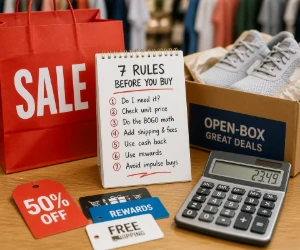
1. Check the Final Price, Not the Sale Price
The price on the product page is only the beginning. Shipping, taxes, delivery fees, required memberships, and other charges can change the value of a deal by the time you reach checkout.
This matters especially when shopping lower-priced deals. A $10 item with a $7 shipping charge may be worse than buying the same product elsewhere for $14 with free delivery.
Stores such as Woot can have excellent limited-time prices, but always take the item all the way to the cart and check the real total before deciding that it is the cheapest option.
See Current Woot Deals2. Do the Math on BOGO Deals
“Buy One, Get One” sounds simple, but not every BOGO promotion gives you the same savings.
- Buy One, Get One Free: If both items cost the same, you are effectively paying half price per item.
- Buy One, Get One 50% Off: If both items cost the same, your total savings are only 25% across the two items.
- Buy More, Save More: The discount may look larger, but only if you genuinely need the extra products.
CVS and other drugstores frequently use multi-buy and BOGO promotions. Before adding the second item, ask whether you would have bought two at the regular price. If not, the promotion may be increasing your spending instead of reducing it.
See Current CVS Deals3. Compare the Unit Price
A larger package is not automatically a better deal, and neither is the package with the biggest percentage-off label. Compare what you are actually getting for each dollar.
For groceries and household products, look at the cost per ounce, count, load, sheet, or other useful unit. For multipacks, divide the total price by the number of items.
A $12 pack of 8 costs $1.50 per item. If a smaller sale pack works out to $1.20 each, the smaller package is actually the better buy.
This is especially useful at stores such as CVS and Walgreens, where coupons, BOGO offers, and rewards can make different package sizes look cheaper than they really are.
4. Treat Cash Back and Rewards as Money You Get Later
A $20 purchase that earns $10 in rewards still requires you to spend $20 today. The reward only becomes valuable if you receive it, use it before it expires, and spend it on something you actually need.
Walgreens is a good example. Walgreens Cash and Register Rewards can make everyday products much cheaper, but each reward system has its own rules and expiration conditions.
Before buying because of a reward, check:
- how much you must spend to qualify;
- whether coupons affect the qualifying amount;
- when the reward is issued;
- when it expires;
- and whether you will realistically use it.
If you spend another $15 just to use a $5 reward, the original “savings” may have encouraged another unnecessary purchase.
See Current Walgreens Deals5. Check Refurbished, Open-Box and Clearance Condition
A deep discount on electronics, furniture, or appliances sometimes comes with a reason. The item may be refurbished, open box, returned, scratched, discontinued, or sold with different return conditions.
That does not make it a bad deal. Open-box and refurbished products can offer excellent value when the condition and warranty match the price.
Before buying, check the exact condition, included accessories, warranty, return policy, and whether the savings are large enough to make the trade-off worthwhile.
Wayfair's Open Box inventory is a good example. Returned or inspected furniture can cost less than new inventory, but it is important to verify dimensions, condition, and return terms before ordering a large item.
See the Wayfair Savings Guide6. Ask One Question: Would I Buy This Without the Sale?
This may be the most useful rule on the list.
If you would not want the item at all without the discount, saving 40%, 60%, or even 80% does not automatically make it a smart purchase.
A $100 item marked down to $40 saves $60 only if you actually needed or wanted that item. Otherwise, the sale did not save you $60 - it convinced you to spend $40.
Large department-store promotions at places such as JCPenney can make it tempting to add clothes, home products, jewelry, or beauty items simply because several categories are discounted at once. Start with what you need, then look for the discount - not the other way around.
See Current JCPenney Deals7. Do Not Spend $20 to Save $7 on Shipping
Free-shipping thresholds are designed to make adding one more item feel reasonable. Sometimes it is. Sometimes that extra item costs far more than the shipping you were trying to avoid.
If your cart is $8 below the free-shipping minimum, compare the choices:
- pay the shipping charge;
- add something you genuinely need;
- wait until you have another planned purchase;
- or check whether pickup or another retailer is cheaper.
Wayfair is a good example because shipping can matter when buying home products. Adding something useful to reach a threshold can make sense, but buying random filler simply to see “FREE SHIPPING” at checkout does not.
A Good Deal Should Still Be a Good Purchase
Coupons, rewards, BOGO offers, clearance prices, and flash sales can absolutely save money. The problem starts when the promotion becomes the reason for buying instead of a way to reduce the cost of something you already wanted.
Before checkout, look at the final total, compare the unit price, understand any reward conditions, check the product condition, and remove anything you added only to unlock another discount.
The best sale is not always the one with the biggest percentage off. It is the one that gets you something useful at a genuinely better final price.
Compare Current Deals Before You Buy
Retail prices and promotions change constantly. Check the latest OFree deal pages before checkout to compare current coupons, markdowns, rewards, and limited-time offers.